Exploring Clee Hill

A friend and colleague recently told me about the clay in her parents garden up on Clee Hill that she used to make stuff out of when she was a child. This morning I went up there and met the wonderful Howard and Pat (her parents), who let me dig some of their clay. I only had a little time, so the clay I dug was near the surface, very pale grey – with quite a bit of charcoal and organic material (roots etc.) and with ochres and small lumps of iron oxide running through it. I’m going to prepare it properly this time, (drying it, breaking it up, slaking it, sieving it etc. before re-drying as a biscuit for future use). I also spied the quarry workings – the hill has been worked for basalt, fireclay, coal and limestone over the centuries… and I’m wondering whether I should go back there to see if I can collect some quarry dust  for future glaze experimentation too….


New glaze experiments in reduction firing

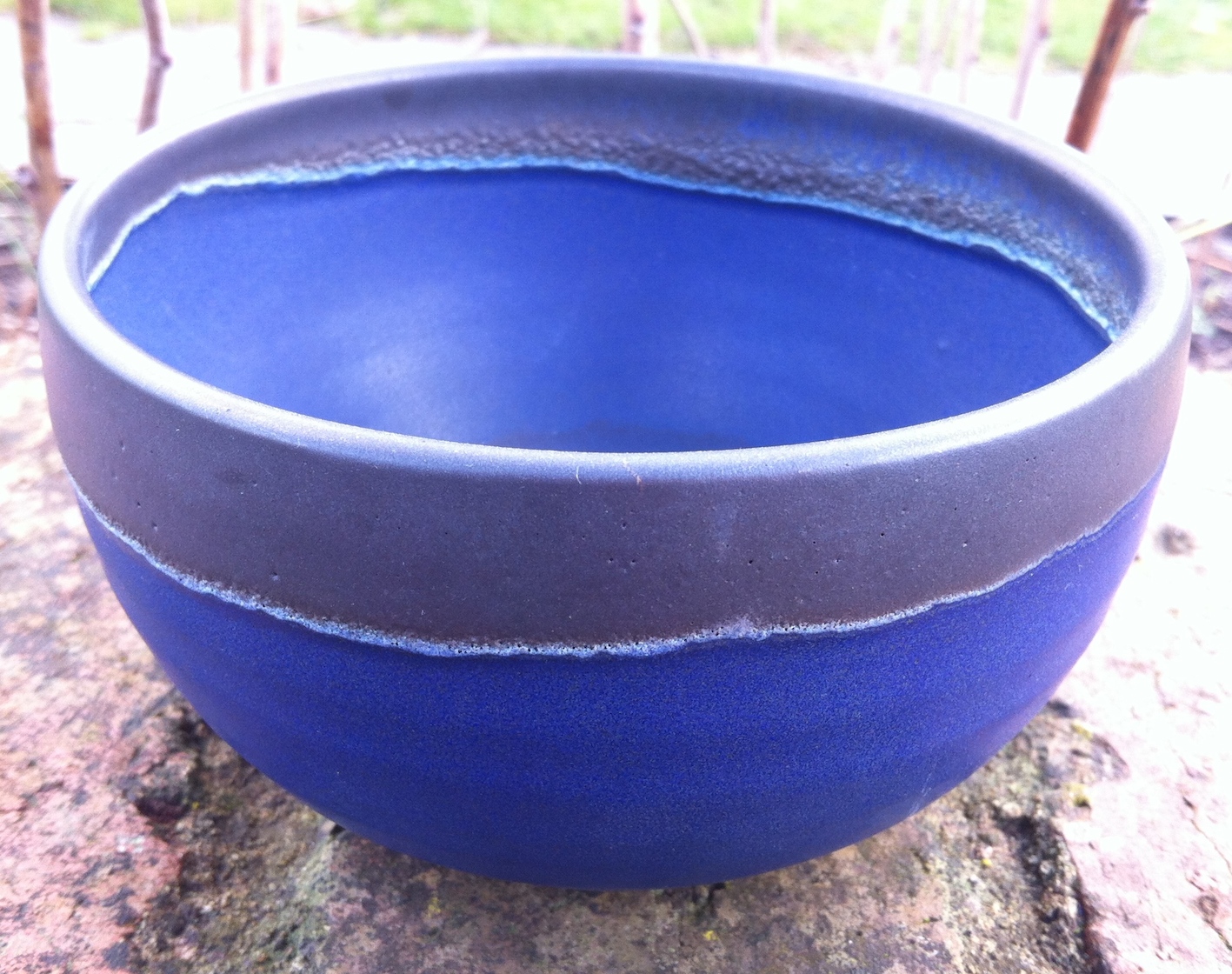
After the last reduction firing, and with lessons learned, I prepared a little more thoroughly and carried out a second reduction firing at Bath-Spa Sion Hill Campus last Tuesday. The results were far more successful and extremely interesting. Tutorial input at the college from Luke Haslam-Jones with expert glaze advise and a really inspiring tutorial with Tana West

(a third year student from the Royal College) are helping me move forward with plans for projects that I need to complete in June; specifically the Creative Sparks internal Bath-Spa project and presentation of our final idea and work so far towards the Holburne Project exhibition (likely to be for October).

Clay as a metaphor for exploring permanence?

As I am working towards my Research Methodologies essay I have been talking to my wife, who recently completed an Artists Teachers Scheme Year in Birmingham. She had come across Clayground Collective and subsequent discussions and then recent visits to their web-site have really interested and inspired me. There are connections with the way that our Learning for Sustainability team worked over the years at Worcestershire County Council, linking sustainability themes such as biodiversity with the arts (see: Worcestershire Parish Mapping Project).

I am becoming fascinated by the idea of using clay as a metaphor to explore sustainability stories or visions. Unfired it is impermanent, which means you can make things that are transitory, changeable, or easy to demolish or that can be left to erode (e.g. when left in the elements – see Adam Buick’s Earth to Earth piece). However, if you want to explore something you wish to see as permanent – that will last thousand years, then you could represent this by firing it, making it ceramic…..

I want to explore this idea with children and young people…. What things do we see around us – that we want to change…. Let’s build those things. Which need to be permanent and which need to be able to metamorphose…? Maybe they all do? And then in the natural world around us… which things do we want to see as permanent – or can we see as permanent? Is anything permanent? Are there creatures or habitats, lifeforms…. that we could make in clay – or maybe fire into some kind of future that we can pass on?

Single Firing….?

I’m currently reading Fran Tristram’s excellent Single Firing: the pros and cons (1996) as an introduction to an approach that would surely cut down on the energy demand from potters by combining the bisc / bisque and glaze firings as one single firing. Along with Fred Olsen’s The Kiln Book (2011) – it makes for essential reading for anyone considering sustainability and ceramics. It’s a very thorough examination of the advantages and disadvantages (weighted in favour of the advantages), with extremely helpful and detailed advice on processes and materials. She gives some interesting figures that compare the firing times for single firings and double firings, which concurred with my recent discussions with Douglas Phillips whose single firings last around 8 hours (firing to cone 9), starting in the morning after an overnight small fire has dried out the kiln by way of preparation (he lights one chamber of his Fred Olsen kiln at 6pm reaching c. 90 degrees C before sealing up the kiln for the night). He sources his timber from a local fencing company (who also supplies John Leech at Muchelney).

Firing is only one aspect of the sustainability debate concerning ceramics, along with sourcing materials and approaches to general practice, distribution etc. and I want to get my hands on Sustainable Ceramics (by Robert Harrison), Pioneer Pottery (by Michael Cardew) and Ceramic Arts and Design for a Sustainable Society (ICS 2011),

Sources:

Tristram, F. (1996) Single Firing: the pros and cons. Ceramic Handbooks

Olsen, F. (2011) The Kiln Book (Fourth Edition). A&C Black

Harrison, R. (2013) Sustainable Ceramics: A practical guide. A&C Black

Cardew, M. (2002) Pioneer Pottery. A&C Black

Jeoung-Ah Kim: edited by, (2011). Ceramic Arts and Design for a Sustainable Society. ICS

“Utility with emptiness”

In researching and preparing for my MA Research Methodologies essay / presentation, I came across a presentation by a former MA (Fine Art) student at Bath Spa University called Hyo Sook Lee and a slide referring to “LaoTzui”, linking to the phrase “utility with emptiness” with a picture of a tea bowl. After some research, I tracked down this quote from Laozi a 6th century Chinese philosopher and author of the Tao Te Ching (often simply referred to as the Laozi:

Thirty spokes converge on a hub, but it’s the emptiness that makes a wheel work, pots are fashioned from clay, but it’s the hollow that make a pot work, windows and doors are carved for a house, but it’s the spaces that make a house work, existence makes something useful, but nonexistence makes it work (from: http://mindfuldiscipline.blogspot.co.uk/2013/03/utility-in-emptiness.html )

I found this phrase profoundly thought provoking and useful. It also connected to some thinking and discussion I am having with a fellow MA (Fine Art) student at Bath Spa, Michie Lyne around the connection between water and clay and utility. The idea that clay only arrives at a plastic, malleable state, when holding a specific quantity of water (i.e. the water is held within), is the first vital stage for a potter and yet it is only when that water is driven off by heat and fired, that the new ceramic, will then hold water externally (i.e. held without…..) linking to the idea of utility with emptiness…..

IMG_0305 - Version 2