New work with materials from Clee Hill….

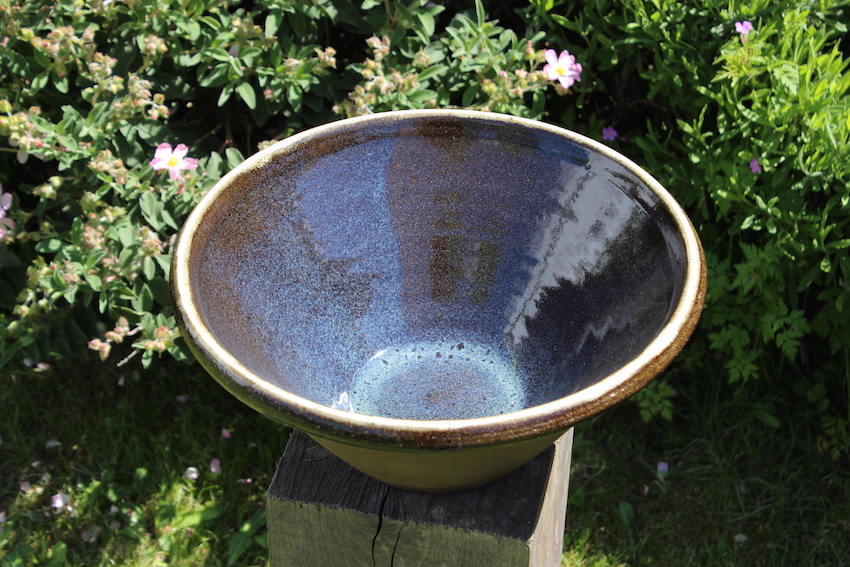
In making a new range of pancheons – or “steens” as they are called in the Shropshire and across the West Midlands, I mixed ingredients from the Clee Hill for glaze tests as I did with my first explorations in 2014 (a mix of local wood ash, the clay I use from Cleehill village & dolerite or “dhustone” dust from the quarry on the hill – see below), experimenting with different percentages again just to check what results were possible. This time I also added small quantities of quartz and I noticed a slight chun effect forming with one of the mixes. I have been absolutely delighted with the results that this mix can achieve – an exquisite speckled blue / silver, on a background of deep, dark brown flecked with green. It is exactly what I have been looking for. That combination of mixing local ingredients with local forms (see next post) to create something useful and beautiful.

This experimental work and finished pieces will be on view on for my stall as part of the University of Bath Spa’s stand in the Learning Zone at the Contemporary Craft Festival at Bovey Tracey (10th-12th June).
IMG_3999
Large 35cm pancheon with chun speckling.
Version 2
“Process” – May 2016.
IMG_4003
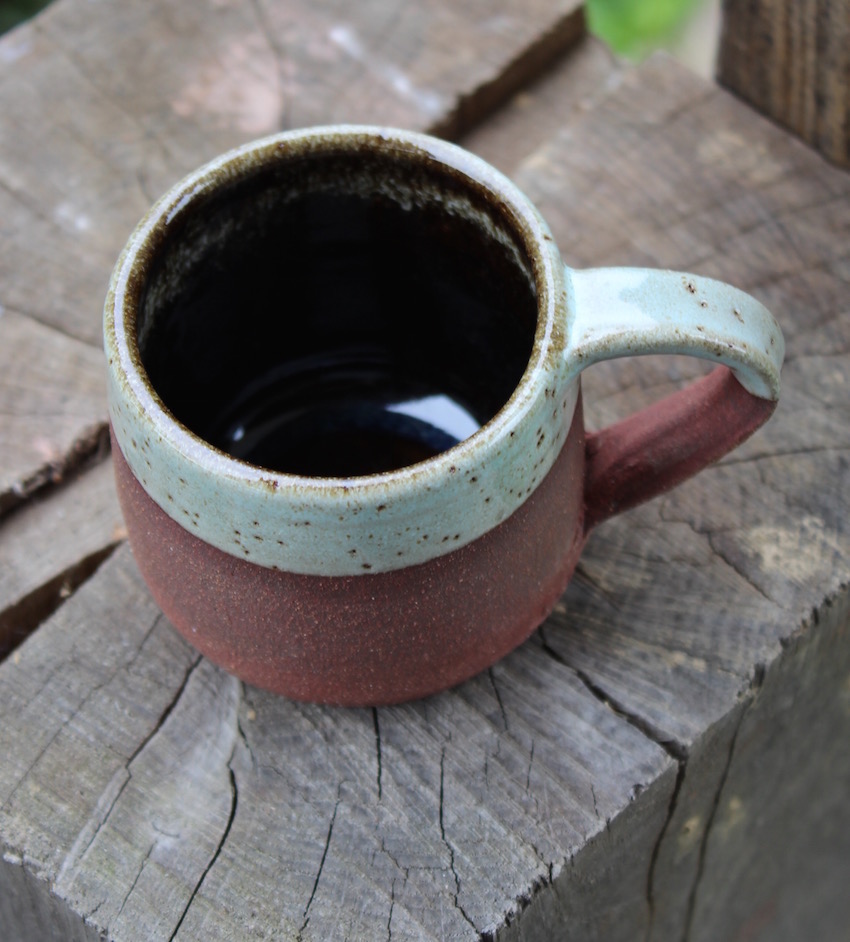
Coffee cup with copper glaze and chun blue speckle.

Landscapes and clay:

Over the last year, my exploration of landscape – specifically linked to places of extraction (of clay, rocks and minerals linked to ceramic manufacture) and / or  production (i.e. the sites of potteries / workshops etc.), has led me back to the concept of palimpsest. The essence of this idea, can be summarized as a surface scraped clean – to be used again, originally relating to the historic re-use of vellum (an ancient material for the production of books), which in the Medieval period was in short supply.

The concept has been translated to a way of viewing landscape by W.G. Hoskins, in his seminal work The Making of the English Landscape (1970) in which he illustrated how palimpsest could be used to describe the landscape itself, as a series of cumulative layers, holding evidence of human activity and a patchwork of clues that could be used to understand changes in human society and economy, and our relationship with the natural environment. My intention was to place this concept centrally in the last creative part of the MA.

Photographs for the MA will go on show for assessment on the 26th January in the basement gallery at Corsham Court. It is not a public show – as our MA Show is booked in to tie in with other MA shows at the School of Art and Design at Sion Hill on the 23rd September. They will also go on show as part of my first public exhibition in the Autumn at Dean Clough, Halifax, which has just been confirmed….(more to follow). The photograph of Titterstone Clee Hill, shown below follows the line of enquiry introduced above. Layers and features are highlighted, but the exact nature, background, detail of these – is another story….

Ref: W, G. Hoskins (1970) The Making of the English Landscape. Penguin.

Version 2
Towards the summit plateau of Titterstone Clee Hill, Shropshire – 2015