In March, following the visit to the Ikon Gallery, we visited the Balke exhibition at the National Gallery. Pedar Balke (1804-1887), was a Norwegian painter and social activist, painting landscapes both on an epic and miniature scale. I am drawn to him because of the beauty of his paintings, his involvement with wider society, and the fact that his work is hugely inspired by walking through Scandinavian arctic landscapes, sketching and recording as he went, (particularly as a young man in the early 1830’s), making a link for me with contemporary artists such as Richard Long. As a family we were particularly captivated by the final wall of miniature landscapes, mostly Balke’s later works, with his use of black and white paint where brush and finger tip strokes are all evident. This may well transfer itself to my own experiments with slip, clay and other materials over the next few weeks…. The painting below is Northern Lights over a Coastal Landscape (1870).
Reflection on A.K. Dolven’s amazing Please Return (Ikon Gallery, Spring 2015)
In February I was lucky enough to catch A.K. Dolven’s amazing installation, Please Return at the Ikon Galery . It came just after finishing our last practice based module, as I started our penultimate module, Analysis of Contemporary Context, which was perhaps ideal timing. In challenging myself to think where my deepest connections with the world around me stem from, I have been thinking a lot about W.G. Hoskins’ The Making of the English Landscape (1970 – original print 1955) which I read during my last year of school in 1980. it’s impact on me was profound. Inspired by my uncle, Richard Westmacott’s work for the Countryside Commission at the time and his work on New Agricultural Landscapes, I was struck by Hoskins’ central concept of the landscape as a palimpsest, layer upon layer of evidence from millennia of human impact and management. In many ways, I suppose this led ultimately to my degree in Archaeology, linked with my passion for the environment, MSc at Bangor (Rural Resource Management) etc… And of course to my making connections between landscape and my current ceramic work. The issue of rapid change, across environment and society, is perhaps the most fundamental linking feature, and challenge of our age. It is a theme that I need to explore further, artistically and in my educational work. Dolven’s beautiful installation, focusing on her responses to a trip to the antarctic, with it’s combination of image, video and artefact, for example Pedar Balke’s wonderful miniature nineteenth century arctic landscapes, (e.g. Balke’s Stormy Sea 1870), really struck a chord with me. Seeing this wide-ranging, multi-media approach to place completely captured my imagination and I found myself reflecting on the beauty, isolation and fragility of the changing polar landscape with fresh perspectives.
Homage to Isaac….
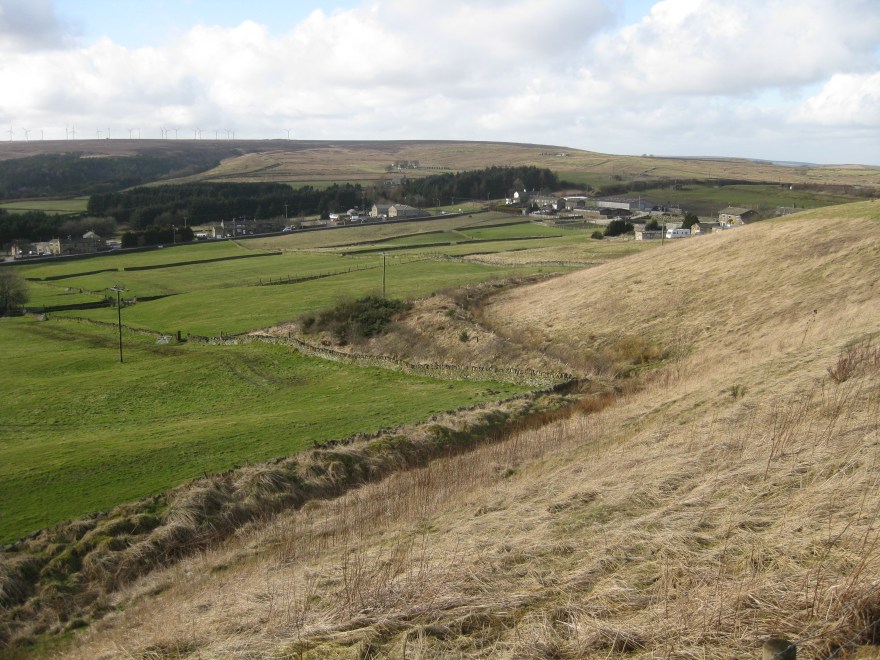
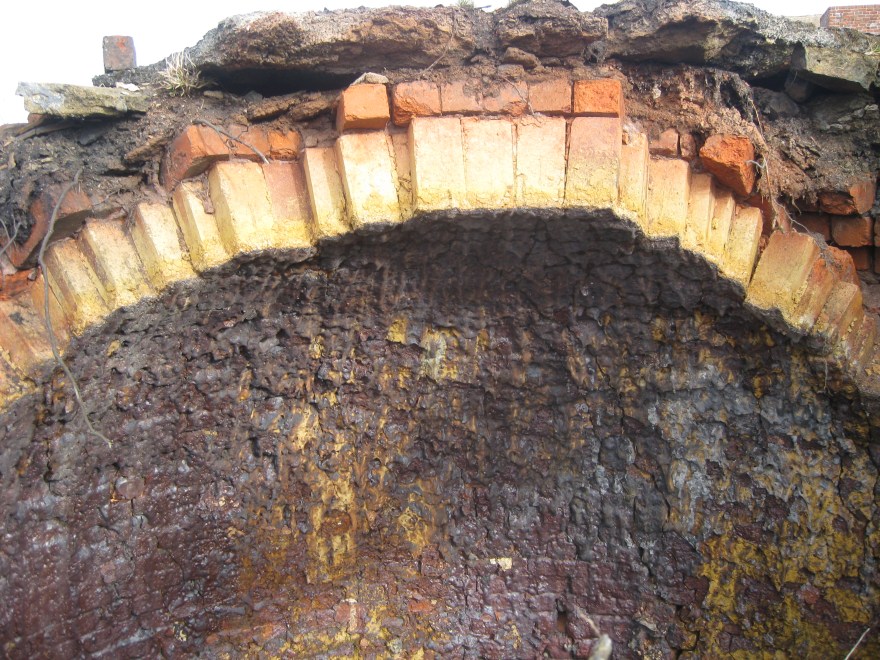
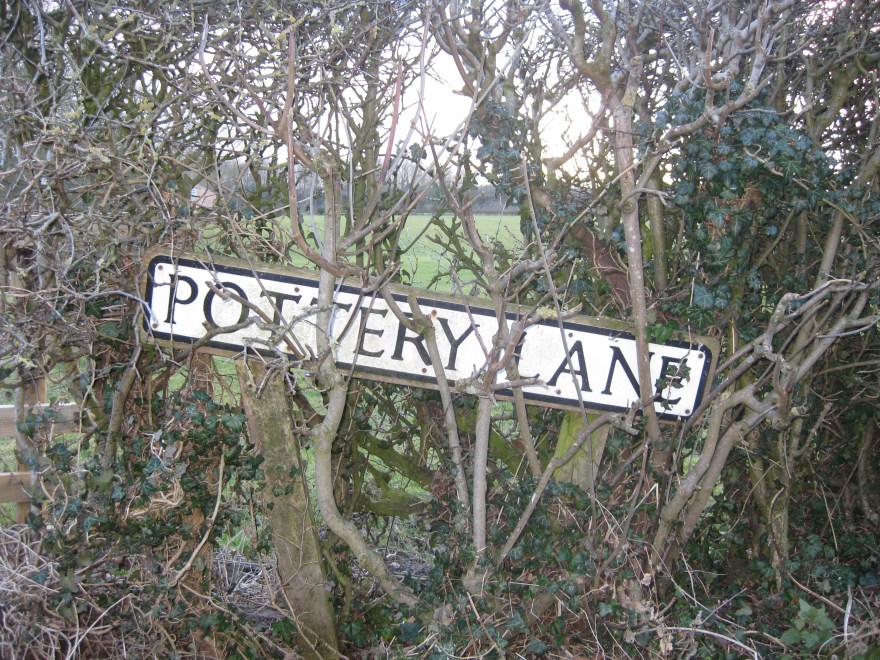
During the same trip to the North East – clay hunting (see below), I stopped just north of Halifax at Soil Hill. I parked on the eastern slopes and walked over the hill, following tracks and bridleways until I came across Isaac Button’s old pottery. It was instantly recognisable from the film clips and blog posts I have seen on other sites. The first evidence I saw was the curving leat, carrying water from the south, carefully terraced into the hillside to the pottery. The chimney at the eastern end of the brick structures is still standing (rebuilt in fact!), but the kiln is in a very precarious condition and I was informed will be taken down to 1m in height as part of the building works now transforming the old brick workshops into apartments. This will be sacrilege to many – and yet the young lads I met who showed me around (on a brief break from their construction work), were incredibly helpful and fascinated by the history of the place themselves. I suppose if money had been raised to secure the site and make a museum of this iconic location – perhaps there could be a different story. But as it is – the place is changing it’s function and character – as is typical of so many old / vernacular buildings in our landscape. The site is littered with shards of broken pots – pancheon rims, lead glazed pieces….. The visit really made me stop and think – this wild, windswept spot was where Isaac Button dug and processed, by hand, his own clay, throwing up to a thousand pots a day, mostly for sale on a local market (for pennies – the stuff had to be affordable).
Between Halifax and Newcastle I stopped briefly at Littlethorpe – and peered into the Littlethorpe pottery buildings. It was late and the place was closed. I’ll have to return some day soon – famed as it is for it’s production of planters and garden pots produced from a local seem of clay.


Northumberland clay hunting….
A few weeks ago I returned, with an old friend (Stefan Sobell who makes exquisite and incomparable guitars, citterns and mandolins…), to a stream that cuts down from the Hexhamshire moors where we dug clay 25 years ago. The moors here are characterised by beautiful wide expanses, near-horizontal bands of heather, field and woodland, stepping up to the high ground, with stone farmhouses / outbuildings and scattered evidence of bronze age settlement and 17th and 18th century lead workings.The clay that we dug then was lugged back to Newcastle and made into thumb pots, burnished and dustbin fired in sawdust, creating lovely black, shiny pots. This time I wanted to collect some of the clay to see if it would throw, and to collect some soil and wood ash samples to use in glaze experiments.
The soil horizon has a fairly classic profile for an upland valley; alluvium with a layer of iron pan beneath, under which lies the rich dark grey seam of clay of incredible purity – there are hardly any inclusions of grit or organic material.
The clay we dug this time was brought home and kneaded before it could dry out. It threw perfectly into the forms below. I have fired these at 1000 degrees C – the results are shown too. I have dried, pounded, slaked and sieved some of the soil samples and I am waiting for these samples to dry before starting a simple triaxial blend experiment to see what results I get at 1250 degrees C (to start with). I’m guessing that with the rich iron oxide content in one sample – a tenmoku effect may be achieved? I have also included a sample from a local sandstone quarry (huge thanks to Lara at Ladycross Quarries) – taken from the sump where the washed out waste from sawing the stone collects.
For stoneware firing results – we’ll have to wait a week or two until I fire up the kiln.